
Dr. Pam Blog
Dr. Pam Blog
Wednesday, October 21, 2026
By Dr. Pamela Johnson, DVM
Wednesday, October 21, 2026
By Dr. Pamela Johnson, DVM
Cat Urinary Blockage: Know the Emergency Signs
Introduction: If Your Cat Can't Pee, Don't Wait
Your cat walks into the litter box.
He squats.
He strains.
Then he gets out.
A few minutes later, he's back again.
And again.
Maybe you see a few drops of urine.
Maybe nothing comes out at all.
You wonder:
Is he constipated?
Does he have a UTI?
Should I wait and call my veterinarian tomorrow?
If your cat is repeatedly straining and producing little or no urine, especially if your cat is male, I want you to treat this differently:
A urinary blockage is an emergency until proven otherwise.
Don't wait until morning.
Don't wait to see whether he eventually urinates.
Don't assume he's constipated.
And don't assume it's simply another episode of cystitis because he's had urinary problems before.
A complete urethral obstruction prevents urine from leaving the body.
As the hours pass, dangerous changes can occur throughout the body.
Without treatment, a urinary blockage can become fatal.
What Is a Urinary Blockage in Cats?
Urine is produced by the kidneys, travels through the ureters into the bladder, and normally leaves the body through the urethra.
With a urethral obstruction, something prevents urine from passing normally through the urethra.
The kidneys may continue producing urine.
The bladder continues filling.
But the cat cannot empty it.
Pressure increases within the urinary system while metabolic waste and electrolytes that would normally leave through the urine begin accumulating in the body.
This isn't simply:
“My cat is having trouble peeing.”
It can become a whole-body medical crisis.
Why Are Male Cats at Greater Risk?
Both male and female cats can develop urinary disease.
But complete urethral obstruction is especially concerning in male cats because of their anatomy.
The male feline urethra becomes relatively narrow as it approaches the end of the urinary tract.
That narrow passage makes obstruction more likely.
A blockage may involve:
- Urethral plugs
- Inflammatory material
- Crystalline material
- Small stones
- Swelling and inflammation
- Urethral spasm
- A combination of factors
And sometimes the underlying urinary disease is associated with feline idiopathic cystitis, where significant bladder and urethral inflammation occurs without a simple bacterial or stone-related cause.
What Are the Early Signs of a Blocked Cat?
Early obstruction can look remarkably similar to other lower urinary tract problems.
Watch for:
- Repeated trips to the litter box
- Straining to urinate
- Squatting for prolonged periods
- Producing very small amounts of urine
- Producing no visible urine
- Crying or vocalizing in the litter box
- Blood in the urine
- Excessive licking around the penis or genital area
- Restlessness
- Hiding
- Urinating outside the litter box
- Increasing discomfort
The biggest question is:
Is urine actually coming out?
If you aren't sure, that's important.
A male cat making repeated attempts to urinate without producing a normal amount of urine should be evaluated urgently.
“But I Saw a Few Drops Come Out.”
A few drops do not necessarily mean everything is okay.
A cat can be partially obstructed or may pass only a tiny amount of urine despite a serious problem.
Blood, mucus, inflammation, and tiny amounts of urine can also make it difficult for owners to determine what's happening.
Don't use:
“Something came out.”
as proof that your cat isn't obstructed.
Look at the entire picture.
Repeated straining with only tiny amounts being produced still warrants veterinary attention.
Why Owners Sometimes Mistake a Urinary Blockage for Constipation
This is one of the most dangerous misunderstandings.
From across the room, a cat straining to urinate and a cat straining to defecate can look very similar.
Both may:
- Enter the litter box repeatedly
- Squat
- Strain
- Vocalize
- Leave without producing much
Owners may therefore assume:
“He's constipated.”
But if that assumption is wrong and the cat is actually unable to urinate, valuable time can be lost.
If you're unsure whether your male cat is trying to urinate or defecate, contact a veterinarian rather than trying to diagnose it from the posture alone.
What Happens Inside the Body When a Cat Can't Urinate?
This is why obstruction becomes so dangerous.
Normally, the kidneys regulate water, electrolytes, acid-base balance, and the elimination of metabolic waste.
When urine cannot leave the body, that system is disrupted.
A prolonged obstruction can cause:
- Severe bladder distention
- Significant pain
- Dehydration
- Accumulation of metabolic waste
- Kidney dysfunction
- Acid-base abnormalities
- Dangerous electrolyte disturbances
One of the biggest concerns is hyperkalemia, or abnormally high blood potassium.
Severe hyperkalemia can interfere with the heart's normal electrical activity and lead to life-threatening cardiac abnormalities.
As the cat becomes increasingly ill, you may see:
- Vomiting
- Profound lethargy
- Weakness
- Collapse
- Altered mental state
- Severe dehydration
At that point, we're no longer dealing only with the urinary tract.
We're dealing with a critically ill patient.
How Quickly Can a Urinary Blockage Become Dangerous?
There isn't a safe number of hours you should wait at home.
The severity depends on factors including:
- Whether the obstruction is complete or partial
- How long it has been present
- Kidney function
- Hydration
- Potassium level
- The cat's overall health
Some cats deteriorate faster than others.
That's precisely why I don't want owners trying to calculate:
“How long has it been?”
If your cat may be obstructed, the right question is:
“Where can I get him evaluated now?”
What Are the Advanced Emergency Signs?
As obstruction progresses, a cat may develop:
- Vomiting
- Severe lethargy
- Weakness
- Refusal to eat
- Increasingly painful behavior
- Hiding
- Difficulty standing
- Collapse
- Abnormal heart rate or rhythm
- Reduced responsiveness
A cat that was restless and repeatedly visiting the litter box may eventually become very quiet.
Do not mistake that quietness for improvement.
A suddenly subdued blocked cat may be becoming critically ill.
What Causes Urinary Blockage?
There isn't one universal cause.
Obstruction can involve combinations of:
Urethral Plugs
Material containing proteins, cells, inflammatory debris, and sometimes crystals can contribute to obstruction.
Bladder or Urethral Stones
Small stones may move into the urethra and become lodged.
Inflammation
Significant inflammation can narrow the urethral passage.
Urethral Spasm
Pain and inflammation can contribute to urethral spasm, making normal urine passage even more difficult.
Feline Idiopathic Cystitis
FIC is an important cause of lower urinary tract inflammation in cats and can contribute to obstructive episodes in susceptible males.
Often, the situation isn't as simple as:
“One crystal plugged the urethra.”
Multiple factors may be occurring simultaneously.
Are Crystals Always the Cause?
No.
This is another common misconception.
Owners often hear “blocked cat” and immediately assume crystals caused it.
Crystals may contribute in some cases.
But cats can obstruct without crystals being the primary problem.
And a cat can have urinary crystals without being obstructed.
The significance of crystals depends on the:
- Type
- Amount
- Urine environment
- Presence of stones
- Presence of inflammation
- Cat's overall clinical picture
That's why treatment shouldn't be based on one isolated finding.
Is a Urinary Blockage the Same as a UTI?
No.
A urethral obstruction means urine cannot flow normally through the urethra.
A urinary tract infection involves infection—usually bacterial—within the urinary tract.
A cat may have urinary inflammation without bacterial infection.
Feline idiopathic cystitis is another possibility.
Bladder stones are another.
These conditions can produce similar signs, which is why veterinary evaluation matters.
Straining does not automatically mean infection.
And antibiotics cannot mechanically open an obstructed urethra.
What Happens at the Emergency Hospital?
Treatment depends on how sick the cat is when they arrive.
The veterinary team may begin with rapid assessment of:
- Heart rate and rhythm
- Hydration
- Bladder size and firmness
- Pain
- Temperature
- Overall stability
Diagnostics commonly include bloodwork to assess concerns such as:
- Potassium
- Kidney values
- Electrolytes
- Acid-base changes
- Other abnormalities
Imaging may also be recommended depending on the case.
If the cat is unstable, stabilization may need to begin immediately.
How Is the Blockage Relieved?
The cat typically requires sedation or anesthesia.
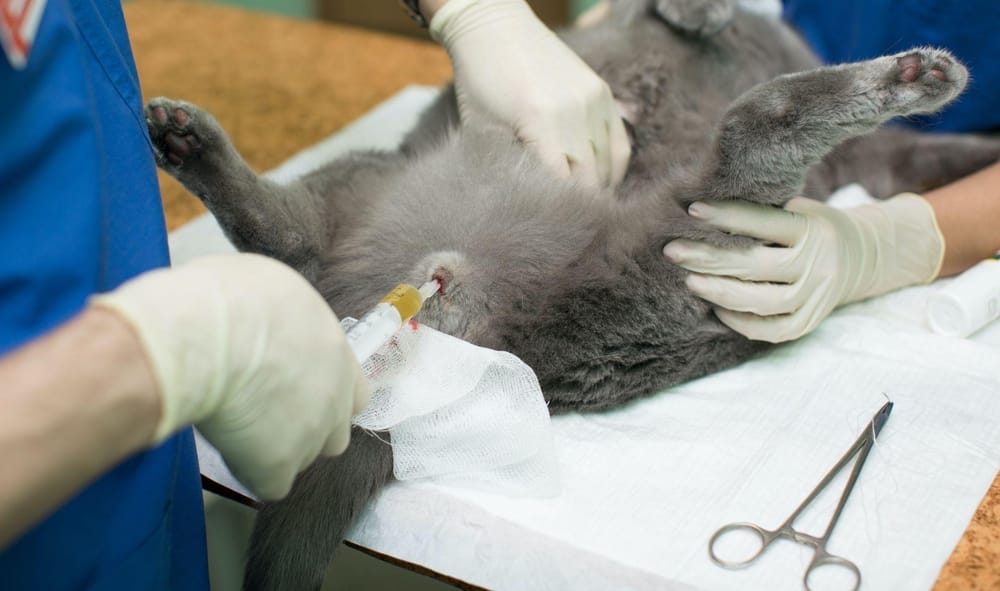
The veterinary team carefully passes a urinary catheter through the urethra to relieve the obstruction and establish urine flow.
The bladder may be decompressed and the urinary tract managed according to the individual case.
An indwelling urinary catheter is often left in place temporarily while:
- Urine output is monitored
- Inflammation begins settling
- IV fluids are administered
- Kidney and electrolyte abnormalities improve
- Pain is controlled
- The cat is monitored for complications
This is not something that can safely be managed at home.
Why Does My Cat Need to Stay in the Hospital After He Can Pee Again?
Owners sometimes understandably think:
“The catheter opened the blockage. Why can't he come home?”
Because opening the urethra is only part of the treatment.
The veterinary team may still need to monitor:
- Kidney function
- Potassium and other electrolytes
- Hydration
- Urine production
- Pain
- Blood pressure
- Cardiac abnormalities
- Whether the cat can urinate independently after catheter removal
Some cats produce very large amounts of urine after an obstruction is relieved.
This is called post-obstructive diuresis.
Those cats can lose substantial amounts of fluid and electrolytes and may require careful IV fluid therapy and monitoring.
Unblocking the cat is the beginning of recovery—not necessarily the end of treatment.
What Happens After the Urinary Catheter Is Removed?
The veterinary team wants to see whether the cat can urinate independently.
This is an important milestone.
A cat may still:
- Urinate frequently
- Pass smaller amounts initially
- Have some blood in the urine
- Experience residual bladder or urethral inflammation
The veterinary team evaluates the entire picture before determining whether the cat is ready to go home.
Can a Cat Block Again?
Unfortunately, yes.
Re-obstruction is possible, particularly during the period after an initial episode.
That's why discharge instructions matter.
At home, owners may be asked to monitor:
- Urine production
- Litter box frequency
- Straining
- Appetite
- Water intake
- Comfort
- Medication administration
- Overall behavior
If the cat begins repeatedly straining again and little or no urine is produced:
Go back.
Do not assume it's normal recovery.
What Does Treatment Look Like After the Emergency?
Long-term management depends on what contributed to the obstruction.
Your veterinarian may recommend some combination of:
- Increased water intake
- More wet food
- A prescription urinary diet
- Pain management
- Environmental modification
- Stress reduction
- Improved litter box resources
- Follow-up urinalysis
- Follow-up imaging
- Additional investigation for stones or recurrent disease
The plan for a cat with bladder stones may be different from the plan for a cat with recurrent FIC.
There isn't one universal “blocked cat diet” or medication plan that fits every patient.
Hydration Matters
Increasing water intake is often an important part of long-term urinary management.
Strategies may include:
- Feeding canned food when appropriate
- Adding water to food if the cat accepts it
- Offering multiple water stations
- Providing fresh water daily
- Trying wide bowls
- Trying a fountain
- Keeping water away from areas the cat finds stressful
The goal is often to increase total water consumption and encourage more dilute urine.
Stress Management Matters Too
For cats whose lower urinary disease includes feline idiopathic cystitis, treating only the urinary tract may miss part of the problem.
Environmental stress can contribute to FIC flare-ups.
Think about:
- Inter-cat conflict
- Inadequate litter boxes
- Resource guarding
- Household changes
- Boredom
- Lack of hiding places
- Lack of vertical spaces
- Unpredictable routines
- Outdoor cats visible through windows
- Forced interactions
Environmental modification can be a legitimate component of medical management.
Litter Boxes Deserve Attention
A good general starting point is:
One litter box per cat, plus one extra.
But placement matters too.
If you have three boxes lined up beside each other in one room, your cats may perceive them more like one litter-box location than three truly separate resources.
Spread resources through the home when possible.
Consider:
- Large boxes
- Unscented litter
- Regular scooping
- Quiet locations
- Easy access
- Multiple levels of the home
- Whether another cat can block access
For a cat recovering from urinary disease, you want using the litter box to feel easy and safe.
What Is a Perineal Urethrostomy?
Some male cats experience recurrent urethral obstruction despite appropriate medical and environmental management.
In selected cases, a veterinarian may discuss perineal urethrostomy, commonly called a PU surgery.
During this procedure, the narrowest portion of the male urethra is surgically removed and a wider urinary opening is created.
PU surgery can substantially reduce the risk of future obstruction at that narrow portion of the urethra.
But it does not cure every form of lower urinary tract disease.
A cat can still experience:
- Cystitis
- Bladder inflammation
- Stones
- Urinary infections
- Other urinary problems
PU is therefore not:
“A cure for urinary disease.”
It's a surgical strategy used in appropriate patients to address the risk of recurrent urethral obstruction.
What Should You NOT Do at Home?
If you suspect a urinary blockage:
Don't Press on the Bladder
Trying to squeeze or manually express a painful, obstructed bladder can cause serious injury.
Don't Give Leftover Antibiotics
Antibiotics will not open an obstructed urethra.
Don't Give Human Pain Medication
Many human medications are dangerous or potentially fatal to cats.
Don't Try Home Remedies
Cranberry products, supplements, apple cider vinegar, herbal products, or dietary tricks cannot safely relieve a complete urethral obstruction.
Don't Wait for Your Cat to “Work It Out”
An obstruction requires veterinary treatment.
Don't Assume It's Constipation
If you aren't sure whether your cat is trying to urinate or defecate, call a veterinarian.
Common Mistakes to Avoid
“He's Still Eating, So He Can't Be Blocked.”
Early in an obstruction, a cat may still behave relatively normally.
“A Few Drops Came Out, So He's Fine.”
Tiny amounts do not rule out a serious urinary problem.
“He's Had Cystitis Before. It's Probably That Again.”
A cat with previous FIC can still become obstructed.
“I'll See What Happens Overnight.”
Don't wait on a possible obstruction.
“It's Probably Just a UTI.”
Maybe—but you cannot safely make that distinction at home.
“He Got Unblocked, So the Emergency Is Over.”
Recovery and monitoring remain important after urine flow is restored.
“Once He Has PU Surgery, He Can't Have Urinary Problems.”
PU reduces obstruction risk in appropriate cats but doesn't eliminate bladder disease.
When Is It an Emergency?
This entire article comes down to one practical rule.
Go to a veterinarian or emergency hospital immediately if your cat:
- Repeatedly strains to urinate
- Produces little or no urine
- Cannot urinate
- Makes frequent unsuccessful litter-box trips
- Cries while attempting to urinate
- Develops vomiting along with urinary straining
- Becomes weak or profoundly lethargic
- Collapses
- Develops severe abdominal discomfort
- Seems progressively worse
And again:
Male cats deserve especially urgent attention.
If you cannot tell whether urine is being produced, don't wait for certainty.
Modern Veterinary Insight: The Cat Can Look Better Than the Lab Work
One of the dangerous things about urinary obstruction is that outward appearance doesn't always tell us how serious the internal changes have become.
A cat may initially walk into the hospital alert and responsive while bloodwork reveals significant electrolyte or kidney abnormalities.
Another cat may arrive critically ill.
That's why I don't want owners waiting for dramatic symptoms.
The goal is to recognize the pattern before the cat collapses.
Repeated litter-box trips.
Straining.
Little or no urine.
That's enough to act.
A Final Thought From Dr. Pam
If there's one feline emergency I wish every cat owner could recognize instantly, this is near the top of my list.
Because I've seen how easy it is to misunderstand.
“He's constipated.”
“He has another UTI.”
“He's still eating.”
“He peed a little bit.”
“I'll call in the morning.”
Those assumptions can cost valuable time.
Your cat doesn't need to be collapsed to have an emergency.
He doesn't need to stop eating first.
And he doesn't need to look critically ill.
If your male cat keeps going to the litter box, keeps straining, and you're not seeing normal urine:
Believe what that behavior is telling you.
Get him evaluated.
I'd much rather tell you:
“Good news—he isn't blocked.”
than meet your cat hours later when the consequences of an obstruction have become far more dangerous.
Bottom Line
A feline urethral obstruction is a life-threatening emergency.
Remember:
- Male cats are at greatest risk
- Repeated litter-box trips can be an early warning sign
- Straining can be mistaken for constipation
- Producing a few drops does not necessarily rule out obstruction
- A blocked cat may initially appear relatively normal
- Dangerous potassium and metabolic abnormalities can develop
- Vomiting, weakness, profound lethargy, and collapse are advanced warning signs
- Antibiotics cannot relieve a mechanical obstruction
- Never try to squeeze an obstructed cat's bladder
- Veterinary treatment generally requires catheterization and medical stabilization
- Hospitalization may still be necessary after urine flow is restored
- Post-obstructive diuresis can require careful monitoring
- Re-obstruction can occur
- Diet, hydration, weight, stress, and environmental management may be important afterward
- Some recurrently obstructed cats may benefit from PU surgery
- PU surgery does not eliminate every form of feline urinary disease
Most importantly:
If your cat—especially a male cat—is repeatedly straining and producing little or no urine, treat it as an emergency until a veterinarian proves otherwise.
🐾 Want Help Making Smarter Pet Health Decisions?
If this article helped you feel more informed or supported, I’d love to stay connected.
Subscribe to the free weekly PetLovers United newsletter for veterinarian-led education, practical tips, and real-life insights that help you care for the pets you love.
👉 https://www.petlovers-united.com/newsletter
And if you want deeper guidance, tools, and direct support:
Explore the PetLovers United membership, where we help you recognize problems earlier, ask better questions, and confidently care for your pet at every stage of life.
👉 https://www.petlovers-united.com/membership-comparison
PetLovers United | www.petlovers-united.com | Educational Content Only
Enjoying The Blogs? Stay Connected
Join our Free Educational Community to help you make informed decisions and become your pet's best advocate.
Always free. No membership required.

Opening Hours:
Monday – Friday 8am – 9pm
Phone: (310) 495 – 7015
Email: info@PetLoversUnited.com
Address:
Opening Hours:
Monday – Friday 8am – 9pm
Phone: (310) 495 – 7015
Email: info@petlovers-united.com
10 Franklin Hwy.
Suite 188
Newnan, GA 30263
USA