
Dr. Pam Blog
Dr. Pam Blog
Friday, October 16, 2026
By Dr. Pamela Johnson, DVM
Friday, October 16, 2026
By Dr. Pamela Johnson, DVM
Feline Cystitis: Why Your Cat Is Straining, Peeing Frequently, or Urinating Outside the Litter Box
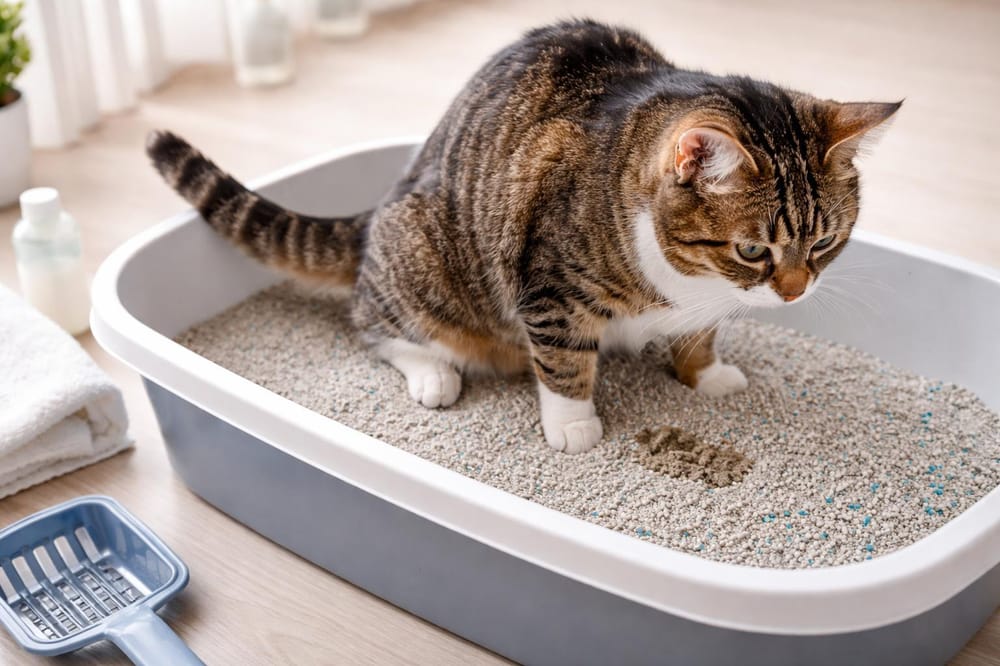
When Litter Box Changes Are More Than Just a Behavior Problem
Your cat suddenly starts making trip after trip to the litter box.
They squat.
They strain.
Maybe only a few drops of urine appear.
Perhaps you notice blood.
Or your cat—who has reliably used the litter box for years—suddenly urinates on the bathroom rug, your laundry, or even your bed.
Many owners immediately think:
“My cat has a UTI.”
Maybe.
But in cats, urinary signs are more complicated than that.
One of the most important conditions pet owners should know about is feline cystitis, or inflammation of the urinary bladder.
And in many cats, particularly younger and middle-aged otherwise healthy cats, we may never find bacteria, bladder stones, or another obvious underlying cause.
That's when we may begin talking about:
Feline idiopathic cystitis, or FIC.
FIC can be painful, frustrating, recurrent, and strongly influenced by a cat's environment and stress response.
But before we talk about FIC, there's one urinary emergency every cat owner needs to recognize.
First: Is Your Cat Actually Producing Urine?
If your cat is repeatedly entering the litter box, straining, and producing little or no urine, don't assume it's simply cystitis.
A urethral obstruction—or urinary blockage—can look very similar at first.
This is particularly important in male cats.
A blocked cat may:
- Make repeated trips to the litter box
- Strain intensely
- Produce only drops or no urine
- Cry or vocalize
- Lick the genital area
- Become restless
- Hide
- Vomit
- Stop eating
- Become increasingly lethargic
As the obstruction continues, dangerous electrolyte and metabolic abnormalities can develop.
Without treatment, a complete urinary obstruction can become fatal.
A male cat repeatedly straining and producing little or no urine should be evaluated as an emergency.
Don't wait until morning to see whether it improves.
What Is Cystitis in Cats?
Cystitis simply means inflammation of the bladder.
It describes what is happening—not necessarily why it's happening.
A cat showing lower urinary tract signs could potentially have:
- Feline idiopathic cystitis
- Bladder or urethral stones
- Crystals
- Urethral obstruction
- Bacterial urinary tract infection
- Anatomic abnormalities
- Trauma
- Neurologic disease
- Bladder tumors or polyps
- Other urinary disorders
This collection of disorders is often discussed under the broader term:
Feline lower urinary tract disease, or FLUTD.
FLUTD isn't one specific disease.
It's an umbrella term describing conditions that affect the bladder and urethra and produce similar clinical signs.
That's why looking at symptoms alone usually cannot tell us exactly what's causing them.
What Is Feline Idiopathic Cystitis?
The word idiopathic essentially means that we cannot identify one specific underlying cause.
With feline idiopathic cystitis, the bladder becomes inflamed and painful even though diagnostic testing may fail to identify an infection, stone, tumor, or another obvious explanation.
But “idiopathic” does not mean:
“Nothing is wrong.”
And it certainly doesn't mean the symptoms are imaginary.
These cats can experience very real bladder inflammation and pain.
Our understanding of FIC has also evolved considerably.
Rather than viewing it as simply an isolated bladder problem, veterinarians increasingly recognize FIC as a complex condition involving interactions among the:
- Nervous system
- Stress-response system
- Bladder
- Environment
- Individual cat's susceptibility
For some cats, the bladder appears to be one of the places where an abnormal stress response becomes physically expressed.
Stress Can Affect a Cat's Bladder
When owners hear that stress may contribute to FIC, they sometimes imagine an obviously frightened cat hiding under a bed.
But feline stress can be much subtler.
A cat may still eat, play, sleep on your lap, and appear relatively normal while experiencing environmental stress.
Potential triggers can include:
- A new pet
- A new baby
- Moving
- Visitors
- Construction
- Changes in routine
- Conflict with another cat
- Outdoor cats visible through windows
- Inadequate litter box resources
- Changes in litter
- Feeding changes
- Boredom
- Lack of hiding or climbing opportunities
- Unpredictable interactions
- Competition for food, water, resting areas, or litter boxes
And sometimes owners cannot identify a specific trigger at all.
That doesn't mean one isn't present.
What Are the Signs of Cystitis in Cats?
Common signs include:
- Frequent trips to the litter box
- Straining to urinate
- Passing small amounts of urine
- Blood in the urine
- Urinating outside the litter box
- Crying or vocalizing while urinating
- Excessive licking around the genital area
- Restlessness
- Hiding
- Irritability
- Changes in normal litter box behavior
Some cats may also begin avoiding the litter box.
This can happen because they associate the box with pain.
That's an important behavioral distinction.
Your cat may not be rejecting the litter box. They may be trying to escape the place where they remember hurting.
Your Cat Isn't Doing This Out of Spite
This deserves its own section.
When a cat urinates on a bed, couch, laundry pile, or rug, owners understandably become frustrated.
But sudden inappropriate urination should not be treated as revenge or spite.
Cats don't develop cystitis to punish us.
A cat urinating outside the litter box may be experiencing:
- Pain
- Urgency
- Increased frequency
- Fear associated with the litter box
- Environmental stress
- Another medical problem
Punishment can make the situation worse by increasing stress.
Sudden litter box changes deserve investigation, not discipline.
Is Cystitis the Same as a UTI?
No.
This is one of the biggest misconceptions surrounding feline urinary disease.
Cystitis means bladder inflammation.
A urinary tract infection means microorganisms—usually bacteria—are infecting part of the urinary tract.
The symptoms can look remarkably similar.
A cat with either condition may:
- Strain
- Urinate frequently
- Pass small amounts
- Have blood in the urine
- Urinate outside the box
You cannot reliably distinguish them by watching the cat at home.
Bacterial urinary infections are possible, but they are not the explanation for every cat with urinary symptoms.
UTIs become more important to consider in certain populations, including some older cats and cats with concurrent diseases that increase infection risk.
That's why automatically prescribing antibiotics for every cat with urinary signs isn't ideal medicine.
We should treat the condition the cat actually has.
How Does a Veterinarian Diagnose FIC?
There isn't one single test that says:
“This cat has FIC.”
FIC is generally diagnosed after considering the cat's history, examination, and appropriate diagnostic testing while ruling out other important causes of lower urinary tract disease.
Depending on the individual cat, your veterinarian may recommend:
Physical Examination
The veterinarian may assess:
- Bladder size
- Bladder discomfort
- Hydration
- Abdominal pain
- Overall condition
- Whether obstruction is possible
Urinalysis
Urine can provide information about:
- Concentration
- Blood
- Inflammatory cells
- Crystals
- Glucose
- Protein
- Other abnormalities
Urine Culture
If bacterial infection is suspected, a culture can determine whether bacteria are actually present and which antibiotics may be appropriate.
Imaging
Radiographs or ultrasound may be recommended to look for:
- Bladder stones
- Urethral stones
- Bladder abnormalities
- Masses
- Other urinary changes
Bloodwork
Blood testing may be appropriate depending on the cat's age, clinical signs, history, or concern for systemic disease or urinary obstruction.
The diagnostic plan should fit the individual cat.
What About Crystals?
Owners frequently hear:
“My cat has crystals.”
Crystals can be clinically relevant, but finding crystals in urine does not automatically explain every urinary symptom.
Their significance depends on factors such as:
- Crystal type
- Urine concentration
- Urine pH
- Whether stones are present
- Diet
- Sample handing
- The cat's overall clinical picture
Some cats with FIC may have crystals.
Others do not.
And crystals alone do not equal a urethral obstruction.
Again:
We treat the patient, not one isolated laboratory finding.
How Is Feline Idiopathic Cystitis Treated?
There is no single medication that permanently “cures” every case of FIC.
Treatment usually has two goals:
Help the current painful episode and reduce the likelihood or severity of future episodes.
1. Control Pain
Cystitis hurts.
Pain management is therefore an important part of treatment.
Your veterinarian may prescribe appropriate analgesic medication based on the individual cat's health and severity of signs.
Never give human pain medications unless your veterinarian specifically instructs you to do so.
Several common human medications can be dangerous or fatal to cats.
2. Increase Water Intake
One of our goals in many cats with lower urinary tract disease is to increase water consumption and produce more dilute urine.
Strategies may include:
- Feeding more canned/wet food
- Adding water to food when appropriate
- Providing multiple water stations
- Using wide, comfortable bowls
- Keeping water fresh
- Trying a pet fountain if the cat prefers moving water
Different cats have different drinking preferences.
The goal is to make hydration easy and appealing.
3. Consider an Appropriate Urinary Diet
Some cats may benefit from a therapeutic urinary diet.
Depending on the cat's specific condition, these diets may be designed to influence:
- Urine concentration
- Mineral composition
- Urine pH
- Risk of certain crystals or stones
- Overall urinary environment
But don't assume every cat with FIC needs exactly the same diet.
And don't switch repeatedly among urinary foods based only on internet recommendations.
Diet should match the diagnosis and the individual cat.
4. Reduce Environmental Stress
This is one of the most important parts of long-term FIC management.
Medication alone may not address the entire problem.
Veterinarians often emphasize multimodal environmental modification, sometimes abbreviated MEMO.
The idea is to improve the cat's environment in multiple ways rather than looking for one magical stress-relief product.
The Cat Welfare Five
For cats prone to FIC, I want owners thinking about five major environmental needs:
1. Safe Space
Every cat needs places where they can retreat without being followed or disturbed.
Think:
- Covered beds
- Boxes
- Elevated shelves
- Quiet rooms
- Cat trees
- Protected resting areas
2. Social Interaction—On Their Terms
Some cats love attention.
Others want shorter, more predictable interactions.
Forced handling can create stress even when we mean well.
Let your cat have some control over when interactions begin and end.
3. Play and Predatory Outlets
Cats need opportunities to:
- Stalk
- Chase
- Pounce
- Capture
- Explore
- Forage
Interactive wand play, food puzzles, and hunting-style games can help provide those outlets.
4. Environmental Control
Cats generally cope better when their world is predictable and they have choices.
Provide multiple:
- Resting locations
- Water sources
- Feeding areas
- Scratching surfaces
- Litter boxes
This is especially important in multi-cat households.
5. Positive Human Connection
Predictable, gentle, positive interaction can help create security.
For some cats, that's lap time.
For others, it's playing with a wand toy from three feet away.
The cat gets a vote.
5. Improve the Litter-Box Setup
For a cat with urinary problems, litter-box management matters enormously.
A useful general starting point is:
One litter box per cat, plus one additional box.
But number isn't the only consideration.
Also think about:
- Box size
- Box location
- Litter type
- Cleanliness
- Covered versus uncovered preference
- Ease of access
- Privacy without isolation
- Whether another cat can guard the entrance
Whether another cat can guard the entrance
Boxes should generally be large enough for the cat to comfortably enter, turn, dig, and posture.
Many cats prefer unscented litter.
And boxes need regular scooping.
In multi-story homes, having boxes available on different levels can be particularly helpful.
6. Address Multi-Cat Conflict
This is one of the most overlooked sources of feline stress.
Cat conflict doesn't always look like a fight.
It may look like:
- Staring
- Blocking hallways
- Guarding stairs
- Following another cat
- Controlling access to food
- Waiting outside the litter box
- Chasing
- One cat consistently leaving when another arrives
The owner may say:
“They never fight.”
Meanwhile, one cat may be living under constant social pressure.
Resources should be distributed throughout the home so one cat cannot easily control access to everything important.
Do Antibiotics Treat FIC?
Not if there is no bacterial infection.
FIC is not inherently a bacterial disease.
Antibiotics treat susceptible bacterial infections.
They do not treat stress, bladder inflammation caused by FIC, or environmental triggers.
If testing indicates a bacterial urinary infection, antibiotics may absolutely be appropriate.
But:
Blood in the urine does not automatically mean your cat needs antibiotics.
Neither does straining.
Neither does urinating outside the litter box.
Finding the cause matters.
What About Anti-Anxiety Medication?
Some cats with recurrent FIC and significant anxiety or environmental stress may benefit from behavioral medication as part of a broader treatment plan.
But medication should not replace environmental modification.
A pill cannot fix:
- A litter box another cat guards
- Chronic resource competition
- An inaccessible safe space
- Boredom
- An unpredictable environment
For selected cats, medication plus environmental changes can be valuable.
That decision should be individualized with your veterinarian.
How Long Does FIC Last?
Many uncomplicated episodes can improve over several days, sometimes even without specific medical intervention.
But there's a danger in knowing that.
You cannot safely assume a straining cat has a harmless episode of FIC that will resolve on its own.
A urinary obstruction can initially look very similar.
Bladder stones can produce similar symptoms.
So can infection.
The first priority is determining what you're actually dealing with.
Can FIC Come Back?
Yes.
Recurrence is one of the frustrating features of feline idiopathic cystitis.
Some cats experience one episode and never have another obvious problem.
Others have repeated flare-ups.
That's why long-term management matters even after the urine looks normal again.
If stress and environmental factors contribute to your cat's disease, we don't want to abandon those improvements simply because the immediate episode has resolved.
What Can Owners Do at Home to Reduce Future Episodes?
Think beyond the bladder.
Your long-term plan may include:
- Increasing water intake
- Feeding an appropriate diet
- Maintaining a healthy body condition
- Encouraging daily activity
- Providing predictable routines
- Offering hiding and elevated spaces
- Increasing appropriate play
- Providing sufficient litter boxes
- Keeping boxes clean
- Separating important resources
- Reducing inter-cat conflict
- Avoiding abrupt environmental changes when possible
- Introducing changes gradually
- Watching for subtle stress signals
The goal isn't to create a completely stress-free life.
That's impossible.
The goal is to create an environment in which your cat has predictability, choice, resources, and healthy ways to cope.
Common Mistakes to Avoid
Assuming Every Urinary Problem Is a UTI
Many cats with lower urinary tract signs do not have a bacterial infection.
Waiting on a Straining Male Cat
If little or no urine is being produced, treat it as an emergency.
Punishing Inappropriate Urination
Pain and stress can drive litter-box changes. Punishment can make both worse.
Treating Only the Bladder
For cats with FIC, environment and stress management can be critical parts of treatment.
Assuming Crystals Explain Everything
Crystals need to be interpreted in context.
Using Leftover Antibiotics
The current episode may not involve bacteria, and inappropriate antibiotics can complicate future care.
Making Abrupt Diet Changes
Cats can be sensitive to change, and diet decisions should fit the medical problem.
Stopping Environmental Changes Once Symptoms Resolve
FIC can recur.
The long-term goal is reducing future episodes—not simply surviving the current one.
When Should You Call Your Veterinarian?
Schedule veterinary evaluation if you notice:
- Frequent urination
- Blood in the urine
- Urinating outside the litter box
- Straining
- Genital licking
- Vocalizing while urinating
- Recurrent urinary episodes
- Sudden litter-box behavior changes
Even if your cat has had FIC before, don't automatically assume every future episode is the same.
A previous diagnosis does not guarantee the next episode has the same cause.
When Is It an Emergency?
Seek emergency veterinary care if your cat:
- Repeatedly strains but produces little or no urine
- Cannot urinate
- Becomes increasingly distressed while attempting to urinate
- Develops vomiting along with urinary straining
- Becomes weak or profoundly lethargic
- Collapses
- Develops a painful, distended abdomen
- Seems rapidly worse
This is especially important in male cats, whose narrower urethra makes complete obstruction a major concern.
If you aren't sure whether urine is actually coming out:
Don't gamble with it.
Call your veterinary team or emergency hospital.
Modern Veterinary Insight: FIC Is More Than a Bladder Problem
One of the biggest changes in how we think about feline idiopathic cystitis is recognizing that focusing only on the bladder may miss much of the story.
For some cats, FIC appears to involve an altered response to stress combined with individual susceptibility and environmental factors.
That's why modern management often includes more than medication.
We look at:
The cat.
The home.
The other animals.
The litter boxes.
The food and water resources.
The daily routine.
Opportunities for play, hiding, climbing, and choice.
That's not “alternative” medicine.
It's recognizing that the environment can have measurable effects on feline health.
And it gives owners something incredibly valuable:
Ways to participate in prevention at home.
A Final Thought From Dr. Pam
If your cat suddenly starts urinating outside the litter box, please don't begin by asking:
“Why is my cat doing this to me?”
Ask:
“What is my cat trying to tell me?”
Maybe the bladder hurts.
Maybe urination has become urgent.
Maybe the litter box has become associated with pain.
Maybe another cat is making the box feel unsafe.
Maybe something changed in your cat's world that seemed insignificant to you but wasn't insignificant to them.
And sometimes, we need veterinary diagnostics to figure out what's happening.
The most important thing is not to dismiss the behavior.
Cats are exceptionally good at hiding discomfort.
A change in where, when, or how your cat urinates may be one of the earliest clues we get.
Listen to it.
And if your cat is straining without producing urine—especially a male cat—don't wait.
That isn't a behavior problem.
It's an emergency until proven otherwise.
Bottom Line
Cystitis means inflammation of the bladder, but it does not tell us what caused the inflammation.
Remember:
- Feline lower urinary tract signs can have multiple causes
- Feline idiopathic cystitis is a common and painful urinary condition
- “Idiopathic” does not mean nothing is wrong
- FIC is not automatically a bacterial infection
- Stress and environmental factors can contribute to FIC
- Frequent urination, straining, blood, and urinating outside the litter box are common signs
- You cannot distinguish FIC, infection, stones, and obstruction from symptoms alone
- Pain management is important
- Increasing water intake may be beneficial
- Diet should be individualized
- Environmental modification is a major part of FIC management
- Litter-box setup and multi-cat conflict deserve careful attention
- Antibiotics are not appropriate unless bacterial infection is actually suspected or identified
- FIC can recur
- A cat with a previous history of FIC can still develop a different urinary problem later
- A cat—especially a male cat—straining and producing little or no urine needs immediate veterinary attention
And perhaps the most important lesson:
When a cat changes their litter-box behavior, don't assume they're misbehaving. Start by asking whether they're hurting.
🐾 Want Help Making Smarter Pet Health Decisions?
If this article helped you feel more informed or supported, I’d love to stay connected.
Subscribe to the free weekly PetLovers United newsletter for veterinarian-led education, practical tips, and real-life insights that help you care for the pets you love.
👉 https://www.petlovers-united.com/newsletter
And if you want deeper guidance, tools, and direct support:
Explore the PetLovers United membership, where we help you recognize problems earlier, ask better questions, and confidently care for your pet at every stage of life.
👉 https://www.petlovers-united.com/membership-comparison
PetLovers United | www.petlovers-united.com | Educational Content Only
Enjoying The Blogs? Stay Connected
Join our Free Educational Community to help you make informed decisions and become your pet's best advocate.
Always free. No membership required.

Opening Hours:
Monday – Friday 8am – 9pm
Phone: (310) 495 – 7015
Email: info@PetLoversUnited.com
Address:
Opening Hours:
Monday – Friday 8am – 9pm
Phone: (310) 495 – 7015
Email: info@petlovers-united.com
10 Franklin Hwy.
Suite 188
Newnan, GA 30263
USA