
Dr. Pam Blog
Dr. Pam Blog
Monday, October 19, 2026
By Dr. Pamela Johnson, DVM
Monday, October 19, 2026
By Dr. Pamela Johnson, DVM
FIV in Cats: What a Positive Feline Immunodeficiency Virus Test Really Means
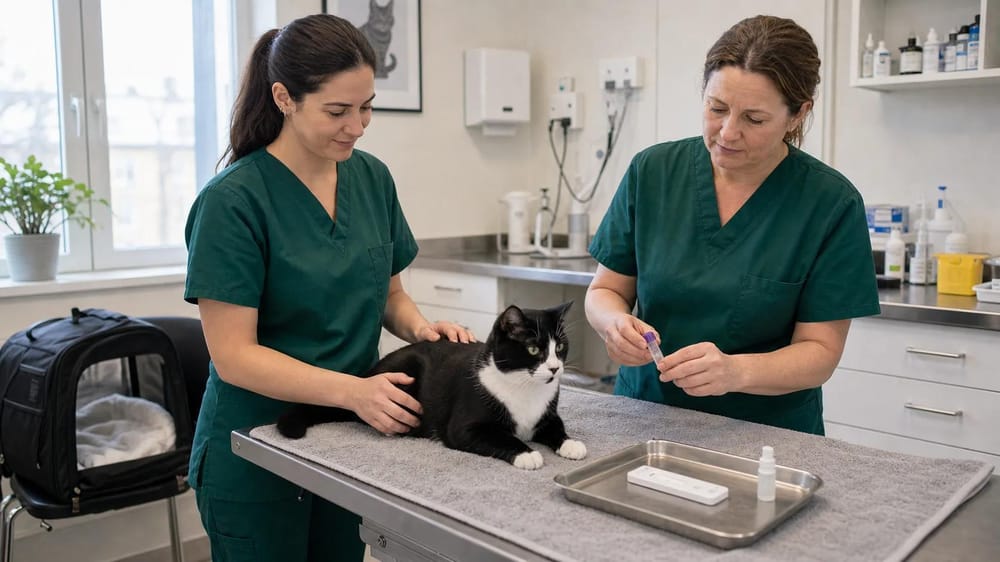
Introduction: “My Cat Tested Positive for FIV. What Does That Mean?”
Few test results frighten cat owners quite like:
“Your cat tested positive for FIV.”
The name doesn't help.
FIV stands for feline immunodeficiency virus.
When owners hear “immunodeficiency,” they may immediately think:
My cat is going to become terribly sick.
My other cats are in danger.
My cat can't live with other cats.
My cat won't live very long.
Or even:
“Do I need to euthanize my cat?”
So before we discuss anything else, I want to make one thing very clear:
An FIV-positive test is not an automatic death sentence.
FIV is a real infectious disease.
It can affect immune function and make some cats more vulnerable to infections and other health problems.
It deserves responsible veterinary care.
But many FIV-positive cats can remain healthy for years and enjoy excellent quality of life.
They can play.
Sleep in the sun.
Chase toys.
Demand breakfast.
Curl up beside you.
And continue being completely, wonderfully themselves.
An FIV diagnosis changes some of the decisions we make about a cat's healthcare and lifestyle.
It does not make that cat less deserving of a home, love, or veterinary care.
What Is FIV?
FIV stands for feline immunodeficiency virus.
It is a retrovirus that infects cats.
FIV primarily affects the immune system.
Over time, infection can impair a cat's ability to respond normally to certain infectious organisms and diseases.
But FIV doesn't affect every cat in exactly the same way.
Some cats remain clinically healthy for long periods.
Others eventually develop health problems associated with immune dysfunction.
That's why we should never look at a positive test and assume we know exactly what the future holds for that individual cat.
Is FIV the Same as FeLV?
No.
This is one of the most important distinctions for cat owners.
FIV and FeLV are different viruses.
Both are feline retroviruses, and both can affect a cat's health.
But they differ in important ways, including:
- How they are commonly transmitted
- their effects on the body
- Disease progression
- Household management
- Prevention strategies
One of the biggest differences is transmission.
FeLV can spread through prolonged close social contact, including activities such as mutual grooming.
FIV transmission is much more strongly associated with deep bite wounds.
That difference has major implications for multi-cat households.
How Do Cats Get FIV?
The primary route of FIV transmission is:
Deep bite wounds from an infected cat.
This most commonly happens during serious cat fights.
An infected cat's saliva can introduce the virus deeply into another cat's tissues through a bite.
This means cats at greatest risk tend to include those that:
- Roam outdoors
- Fight with other cats
- Have access to unfamiliar cats
- Live in environments where aggressive encounters occur
Historically, intact male outdoor cats have represented an important risk group because roaming and territorial fighting increase opportunities for bite wounds.
Can Cats Get FIV From Sharing Food Bowls?
This is where FIV differs substantially from FeLV.
FIV is not considered efficiently transmitted through normal casual social contact.
Transmission through activities such as:
- Sharing food bowls
- Sharing water bowls
- Sharing litter boxes
- Sleeping beside each other
is considered much less likely than transmission through deep bite wounds.
That distinction matters enormously.
An FIV-positive cat doesn't automatically need to live completely isolated from every other cat.
What About Mutual Grooming?
FIV can be present in saliva.
But normal grooming between cats is not considered an efficient route of FIV transmission.
The primary concern remains bite wounds that introduce infected saliva into tissue.
This is why the relationship between cats matters.
Two cats that peacefully sleep together are a very different transmission scenario from two cats that routinely fight and bite each other.
Can FIV Be Transmitted From a Mother to Her Kittens?
Transmission from an infected mother to kittens can occur, but it is considered less common than transmission through bite wounds.
There is another important issue involving kittens:
Maternal antibodies can complicate FIV testing.
We'll come back to that because it's extremely important when interpreting a positive test in a young kitten.
Can Humans Get FIV?
No.
Despite the similarity in the names “feline immunodeficiency virus” and “human immunodeficiency virus,” FIV is species-specific.
FIV does not infect people.
You cannot contract FIV from:
- Petting an FIV-positive cat
- Being licked by your cat
- Sharing your home with an FIV-positive cat
Dogs do not contract feline FIV either.
An FIV-positive cat is not a human health threat.
Which Cats Are Most at Risk?
The highest-risk lifestyle involves opportunities for fighting.
Risk increases with:
- Outdoor roaming
- Territorial aggression
- Cat fights
- Bite wounds
- Contact with unfamiliar cats
- Living in environments with uncontrolled cat populations
This is one reason keeping cats safely indoors can dramatically reduce exposure risk.
What Happens After a Cat Becomes Infected?
FIV infection can progress through different stages.
Early Infection
Some cats experience temporary illness after initial infection.
Signs may be mild enough that owners never notice them.
Possible signs can include:
- Fever
- Enlarged lymph nodes
- Reduced appetite
- Lethargy
These signs can be nonspecific.
Clinically Quiet Period
Many FIV-positive cats then enter a long period where they appear completely healthy.
This period may last for years.
The cat may:
- Eat normally
- Maintain weights
- Play
- Groom
- Behave normally
- Show no obvious evidence of disease
This is one reason an FIV-positive cat can surprise an owner.
They may look perfectly healthy because, at that moment, they are clinically doing well.
Later Immune Dysfunction
Some cats eventually develop more significant immune dysfunction and become more susceptible to chronic or recurrent disease.
The course varies tremendously among individuals.
What Are the Symptoms of FIV?
There isn't one symptom that means:
“This cat has FIV.”
Possible problems can include:
- Weight loss
- Reduced appetite
- Chronic or recurrent fever
- Enlarged lymph nodes
- Poor coat condition
- Chronic or recurrent infections
- Oral inflammation
- Gingivitis or stomatitis
- Dental disease
- Diarrhea
- Eye disease
- Respiratory infections
- Skin infections
- Neurologic abnormalities
- General decline in body condition
Some FIV-positive cats never develop dramatic FIV-associated illness.
Others develop significant disease later in life.
That's why monitoring matters.
How Is FIV Tested?
Common FIV screening tests generally detect antibodies against FIV.
This is an important difference from commonly used FeLV screening tests, which typically detect viral antigen.
In most adult cats that have not been affected by unusual testing circumstances, persistent FIV antibodies can indicate infection.
But no test result should be interpreted without context.
Your veterinarian may consider:
- Age
- Exposure history
- Health status
- Previous testing
- Risk of infection
- Whether the result was expected
- Timing of possible exposure
Additional testing or repeat testing may sometimes be appropriate.
Why Can FIV Testing Be Tricky in Kittens?
This is one of the most important facts rescue groups, foster families, and kitten adopters should know.
Kittens born to FIV-positive mothers may receive maternal antibodies through colostrum.
Those antibodies can cause an FIV antibody test to appear positive even if the kitten itself is not truly infected.
Maternal antibodies can persist for months.
That means:
A positive FIV antibody test in a young kitten does not necessarily prove lifelong FIV infection.
Veterinarians may recommend repeat testing at an appropriate age or interval to determine whether the antibodies persist.
This is particularly important before making permanent placement or medical decisions based on one kitten screening result.
What About a Negative Test After Recent Exposure?
Timing matters here too.
A cat recently exposed to FIV may not immediately have detectable antibodies.
If a recent bite wound or other significant exposure occurred, your veterinarian may recommend repeat testing after an appropriate interval.
So both positive and negative results sometimes need to be interpreted in the context of when exposure may have happened.
Should a Healthy Cat Be Euthanized Because of a Positive FIV Test?
No.
FIV status alone is not a reason to euthanize an otherwise healthy cat.
This deserves to be said plainly.
A positive FIV test should lead to:
Education.
Veterinary planning.
Responsible lifestyle decisions.
Monitoring.
It should not automatically lead to euthanasia.
Quality-of-life decisions should be based on the health and comfort of the individual cat—not simply the presence of antibodies on a test.
Is FIV a Death Sentence?
No.
And this misconception has harmed many cats.
FIV can increase a cat's risk of health problems.
But many FIV-positive cats can live for years with good quality of life.
Some may ultimately develop serious FIV-associated disease.
Others may experience illnesses that have nothing to do with FIV.
An FIV diagnosis does not give us a precise countdown clock.
So rather than asking:
“How long does an FIV cat have?”
ask:
“How is this cat doing, and how can we help keep them healthy?”
Can FIV Be Cured?
At this time, there is no treatment that reliably eliminates established FIV infection.
Management focuses on maintaining health and responding promptly when problems arise.
That can include:
- Preventive veterinary care
- Appropriate nutrition
- Dental care
- Parasite prevention
- Prompt treatment of infections
- Monitoring body weight
- Managing concurrent diseases
- Supporting quality of life
Remember:
No cure does not mean no treatment.
And it certainly does not mean no hope.
Should an FIV-Positive Cat Be Kept Indoors?
Yes, indoor living is generally strongly recommended.
This protects the FIV-positive cat from:
- Cat fights
- Infectious disease exposure
- Parasites
- Trauma
- Wildlife encounters
- Other environmental hazards
It also protects other cats by reducing the possibility that the FIV-positive cat could transmit the virus through fighting and bite wounds.
Indoor living benefits both the infected cat and the surrounding cat population.
Indoor Doesn't Have to Mean Boring
An indoor FIV-positive cat still needs to be a cat.
Provide:
- Window perches
- Cat trees
- Scratching surfaces
- Interactive toys
- Wand-toy play
- Puzzle feeders
- Foraging opportunities
- Hiding places
- Comfortable resting areas
- Vertical territory
- Predictable routines
- Positive social interaction
Safe outdoor experiences may be possible through:
- Secure catios
- Enclosed outdoor spaces
- Supervised harness time for cats that enjoy it
The goal is not merely disease prevention.
It's quality of life.
Can an FIV-Positive Cat Live With FIV-Negative Cats?
This is one of the biggest questions owners and adopters ask.
And the answer is more nuanced than:
“Never.”
Because FIV is primarily transmitted through deep bite wounds, peacefully coexisting cats represent a very different risk scenario from cats that fight aggressively.
In stable households where cats:
- Get along
- Don't fight
- Don't inflict bite wounds
- Have adequate resources
- Have stable social relationships
the risk of transmission is considered much lower.
That does not mean the risk is literally zero.
But it does mean that FIV-positive cats do not automatically require lifelong social isolation.
Household decisions should be made with your veterinarian based on:
- Temperament
- History of aggression
- Number of cats
- Available space
- Resource distribution
- Health status of the cats
- Ability to prevent fighting
The Most Important Question in a Mixed-Status Household
Don't only ask:
“Is one cat FIV-positive?”
Ask:
“Do these cats fight?”
Deep bite wounds are the primary concern.
A household with serious inter-cat aggression is not an appropriate low-risk environment.
And even aside from FIV transmission, chronic fighting is a welfare problem that deserves attention.
Reduce Conflict in Multi-Cat Homes
Good environmental management can help reduce competition and tension.
Provide multiple:
- Food stations
- Water stations
- Litter boxes
- Resting locations
- Hiding places
- Scratching surfaces
- Elevated spaces
Avoid forcing cats to share one small resource area.
Watch for subtle conflict such as:
- Staring
- Blocking doorways
- Guarding litter boxes
- Guarding food
- Chasing
- Cornering
- Ambushing
- Preventing another cat from accessing resources
Not every cat fight looks dramatic.
Preventing conflict protects both physical and emotional health.
Nutrition for FIV-Positive Cats
Feed a complete and balanced diet appropriate for the cat's:
- Age
- Weight
- Health
- Medical conditions
Because immune function may eventually be compromised, minimizing unnecessary exposure to infectious organisms is sensible.
For that reason, raw or undercooked animal products are generally not recommended for immunocompromised cats because of the risk of foodborne pathogens.
Monitor:
- Age
- Weight
- Muscle condition
- Eating behavior
Unexplained weight loss deserves investigation.
Dental and Oral Health Deserve Special Attention
Oral disease can be a significant problem in some FIV-positive cats.
Watch for:
- Bad breath
- Drooling
- Difficulty chewing
- Dropping food
- Pawing at the mouth
- Red or inflamed gums
- Oral pain
- Reduced appetite
Severe inflammatory oral disease can dramatically affect quality of life.
Routine dental assessment and prompt attention to oral discomfort are important.
Preventive Veterinary Care Matters
FIV-positive cats benefit from regular veterinary monitoring.
Depending on the individual patient, your veterinarian may recommend examinations more frequently than once yearly.
Monitoring may include:
- Body weight
- Muscle condition
- Oral health
- Lymph nodes
- Eyes
- Skin
- Coat
- Heart and lungs
- Abdomen
- Bloodwork
- Urinalysis
- Other testing based on age and symptoms
The goal isn't to constantly search for disaster.
The goal is to identify changes early.
Treat Illness Early
An FIV-positive cat may not respond to infection in exactly the same way as an immunocompetent cat.
That means I don't want owners waiting excessively when something clearly changes.
Contact your veterinarian when you notice persistent:
- Reduced appetite
- Weight loss
- Fever
- Vomiting
- Diarrhea
- Coughing
- Sneezing
- Eye problems
- Skin infections
- Wounds
- Oral pain
- Lethargy
- Behavioral changes
Many problems remain treatable.
FIV does not mean we stop treating ordinary disease.
What About Vaccinations?
Vaccination plans for FIV-positive cats should be individualized.
Your veterinarian will consider:
- Lifestyle
- Exposure risk
- Age
- Current health
- Previous vaccination history
- Local disease risks
FIV infection does not automatically mean:
“Never vaccinate this cat again.”
Nor does it mean every vaccine should automatically be given on the same schedule as every other cat.
Preventive medicine should be tailored to the patient.
Is There an FIV Vaccine?
This is an important distinction from FeLV.
In the United States, there is not currently a commercially available FIV vaccine used in routine feline vaccination programs.
So prevention relies heavily on reducing exposure to bite wounds.
That means:
- Indoor living
- Preventing roaming
- Reducing fighting
- Careful introductions
- Managing multi-cat conflict
are major parts of FIV prevention.
How Do I Protect My FIV-Negative Cat?
Reduce opportunities for deep bite wounds.
That means:
- Keep cats indoors or safely contained
- Avoid uncontrolled roaming
- Introduce new cats carefully
- Test cats when appropriate
- Address inter-cat aggression
- Provide adequate household resources
- Don't force incompatible cats to coexist
Prevention isn't just about infectious disease.
It's also about good feline welfare.
What About Introducing an FIV-Positive Cat Into My Home?
Don't automatically reject a wonderful cat solely because they're FIV-positive.
Instead, consider:
- Your existing cats' temperaments
- Whether aggression is likely
- Available space
- Ability to introduce cats gradually
- Resource availability
- Health of the resident cats
- Veterinary guidance
A calm FIV-positive cat may be a very different household risk from an aggressive cat with a history of serious fighting.
The individual cat matters.
FIV-Positive Cats Can Be Adopted
FIV-positive cats can make wonderful companions.
They should not automatically be considered:
- Unadoptable
- Dangerous
- Terminally ill
- Unsuitable for loving homes
Potential adopters simply need accurate information.
They should understand:
- The diagnosis
- Recommended indoor lifestyle
- Veterinary monitoring
- Potential health risks
- Household considerations
Education is far more useful than fear.
Know Your Cat's Baseline Normal
If you live with an FIV-positive cat, become familiar with their normal:
- Appetite
- Weight
- Energy
- Grooming
- Play
- Litter box habits
- Social behavior
- Breathing
- Coat quality
- Oral comfort
You don't need to inspect your cat anxiously every day.
You simply want to recognize:
“This isn't normal for my cat.”
That observation can be incredibly valuable.
Common FIV Myths
MYTH: “FIV and FeLV Are Basically the Same Disease.”
FACT: They are different viruses with important differences in transmission and management.
MYTH: “FIV Spreads Easily Through Food Bowls and Litter Boxes.”
FACT: FIV is primarily transmitted through deep bite wounds. Casual social contact is a much less efficient route.
MYTH: “FIV-Positive Cats Can Never Live With Negative Cats.”
FACT: Stable, non-fighting cats present a very different risk scenario from cats that inflict deep bite wounds. Household decisions should be individualized.
MYTH: “An FIV-Positive Cat Should Be Euthanized.”
FACT: FIV status alone is not a reason for euthanasia.
MYTH: “FIV-Positive Cats Are Always Sick.”
FACT: Many infected cats remain clinically healthy for long periods.
MYTH: “A Positive Kitten Test Means the Kitten Definitely Has FIV for Life.”
FACT: Maternal antibodies can cause positive antibody results in young kittens. Follow-up testing may be necessary.
MYTH: “My FIV-Positive Cat Can't Be Around Me.”
FACT: FIV does not infect humans.
MYTH: “There Is Nothing We Can Do.”
FACT: Preventive care, early treatment, appropriate nutrition, dental care, indoor living, and monitoring can all contribute to health and quality of life.
FIV vs. FeLV: The Quick Difference
FIV
FeLV
Virus
Major transmission concern
Casual household transmission
Can healthy cats test positive?
Can humans catch it?
U.S. preventive vaccine routinely available?
Positive result = euthanasia?
Indoor lifestyle recommended?
Veterinary monitoring important?
Feline immunodeficiency virus
Deep bite wounds
Relatively inefficient
Yes
No
No
No
Yes
Yes
Feline leukemia virus
Close prolonged contact, saliva and other exposures
More important concern
Yes
No
Yes
No
Yes
Yes
The biggest owner takeaway is:
Don't manage FIV as though it were FeLV.
The viruses are different, and the transmission risks are different.
When Should an FIV-Positive Cat See the Veterinarian?
Contact your veterinarian for persistent changes such as:
- Appetite loss
- Weight loss
- Lethargy
- Fever
- Vomiting
- Diarrhea
- Chronic respiratory signs
- Eye abnormalities
- Skin problems
- Wounds
- Enlarged lymph nodes
- Oral pain
- Difficulty eating
- Behavior changes
- Any significant change from baseline
Early investigation is valuable.
When Is It an Emergency?
FIV-positive cats can experience the same emergencies as any other cat.
Seek urgent veterinary care for:
- Difficulty breathing
- Open-mouth breathing
- Collapse
- Severe weakness
- Seizures
- Major trauma
- Significant bleeding
- Severe dehydration
- Repeated vomiting with rapid deterioration
- Inability to urinate
- Severe pain
- Sudden inability to walk
- Rapid decline
Don't assume:
“It's because of the FIV, so there's nothing we can do.”
Find out what's actually happening.
Quality of Life Is About the Cat in Front of You
An FIV diagnosis can make owners fearful of the future.
That's understandable.
But don't allow tomorrow's possibilities to erase today's good life.
Ask:
Is your cat eating?
Playing?
Grooming?
Seeking affection?
Exploring?
Sleeping comfortably?
Interested in their surroundings?
Doing the things that make them themselves?
If so, enjoy those things with them.
Your cat doesn't know their test result.
They know whether they're comfortable.
They know whether they're hungry.
They know whether the sunbeam feels good.
They know whether you're sitting in their favorite chair.
They know whether they feel safe.
That's the life we're protecting.
Modern Veterinary Insight: FIV Status Is Only One Piece of the Patient
A laboratory result gives us important information.
But it does not tell us everything about a cat.
When I evaluate an FIV-positive patient, I still care about:
- Age
- Body weight
- Muscle condition
- Oral health
- Nutrition
- Lifestyle
- Parasite exposure
- Behavior
- Other diseases
- Current clinical signs
- Quality of life
The FIV result belongs in that picture.
It doesn't replace the picture.
That's particularly important when making decisions about:
- Adoption
- Multi-cat housing
- Long-term care
- Treatment
- Quality of life
Treat the patient—not the label.
A Final Thought From Dr. Pam
If your cat has just tested positive for FIV, I want you to remember something.
Your cat didn't change when the test turned positive.
The cat who walked into the veterinary hospital that morning is the same cat who walked out.
They still know your voice.
They still have their favorite sleeping spot.
They still know when dinner is late.
They still have opinions about which side of the couch belongs to them.
Yes, we take FIV seriously.
We keep these cats safely indoors.
We monitor their health.
We pay close attention to dental disease and infections.
We reduce unnecessary infectious exposure.
And we make thoughtful decisions about other cats in the home.
But we don't look at a positive test and decide that a good life is over.
Many FIV-positive cats have a great deal of living left to do.
So don't spend every healthy day waiting for your cat to become sick.
Use what you know to protect them.
Watch for changes.
Work with your veterinary team.
And then:
Let your cat be a cat.
FIV may be part of their medical history.
It does not have to define their life.
Bottom Line
FIV is a serious feline infectious disease, but it is not an automatic death sentence.
Remember:
- FIV stands for feline immunodeficiency virus
- FIV and FeLV are different diseases
- FIV primarily affects immune function
- Deep bite wounds are the major route of transmission
- Outdoor roaming and fighting increase risk
- Casual social contact is a much less efficient transmission route
- Sharing bowls or litter boxes is not the primary transmission concern
- FIV does not infect humans or dogs
- FIV-positive cats may remain clinically healthy for years
- A positive test does not tell us exactly how long a cat will live
- FIV status alone is not a reason for euthanasia
- Young kittens can test positive because of maternal antibodies
- Recent exposure can complicate interpretation of a negative test
- Follow-up testing may sometimes be necessary
- There is currently no cure that reliably eliminates established FIV infection
- Indoor living is strongly recommended
- Indoor cats still need enrichment and opportunities for normal feline behavior
- Raw or undercooked animal products create avoidable infectious-disease risk
- Dental health deserves particular attention
- Routine veterinary monitoring is important
- Illness should be evaluated early
- Vaccination decisions for an FIV-positive cat should be individualized
- There is not currently a routine commercially available FIV vaccine in the United States
- Peaceful FIV-positive and FIV-negative cats may represent a much lower transmission risk than fighting cats
- Mixed-status household decisions should still be made thoughtfully with veterinary guidance
- FIV-positive cats can be wonderful adoption candidates
- Quality of life should be judged by the individual cat—not the diagnosis
Most importantly:
FIV-positive does not mean “dying.”
It means:
We know something important about this cat's health—and now we can use that information to care for them thoughtfully.
🐾 Want Help Making Smarter Pet Health Decisions?
If this article helped you feel more informed or supported, I’d love to stay connected.
Subscribe to the free weekly PetLovers United newsletter for veterinarian-led education, practical tips, and real-life insights that help you care for the pets you love.
👉 https://www.petlovers-united.com/newsletter
And if you want deeper guidance, tools, and direct support:
Explore the PetLovers United membership, where we help you recognize problems earlier, ask better questions, and confidently care for your pet at every stage of life.
👉 https://www.petlovers-united.com/membership-comparison
PetLovers United | www.petlovers-united.com | Educational Content Only
Enjoying The Blogs? Stay Connected
Join our Free Educational Community to help you make informed decisions and become your pet's best advocate.
Always free. No membership required.

Opening Hours:
Monday – Friday 8am – 9pm
Phone: (310) 495 – 7015
Email: info@PetLoversUnited.com
Address:
Opening Hours:
Monday – Friday 8am – 9pm
Phone: (310) 495 – 7015
Email: info@petlovers-united.com
10 Franklin Hwy.
Suite 188
Newnan, GA 30263
USA