
Dr. Pam Blog
Dr. Pam Blog
Thursday, October 15, 2026
By Dr. Pamela Johnson, DVM
Thursday, October 15, 2026
By Dr. Pamela Johnson, DVM
Heartworm Disease in Dogs and Cats: The Truth About Prevention, Treatment, and “Slow Kill”
Introduction: One Mosquito Is All It Takes
Your dog doesn't have to live outside.
Your cat doesn't have to roam the neighborhood.
Your pet doesn't have to live beside a lake.
And you don't have to see mosquitoes swarming around your yard for heartworm disease to be a concern.
Heartworms are transmitted through the bite of an infected mosquito.
That's it.
Dogs don't catch heartworms from other dogs.
Cats don't get them from dogs.
Your pet doesn't pick them up from contaminated soil, another animal's stool, or a water bowl.
A mosquito is required to transmit the infection.
And once heartworms establish themselves inside an animal, we're dealing with a very different problem than simply giving a dewormer.
In dogs, treatment is lengthy, medically complicated, and requires strict exercise restriction.
In cats, the situation is even more sobering:
There is no approved medication that safely eliminates adult heartworms in cats.
That's why I want every pet owner to understand something before we go any further:
Heartworm disease is much easier to prevent than it is to treat.
What Exactly Is a Heartworm?
Heartworms are parasitic worms called Dirofilaria immitis.
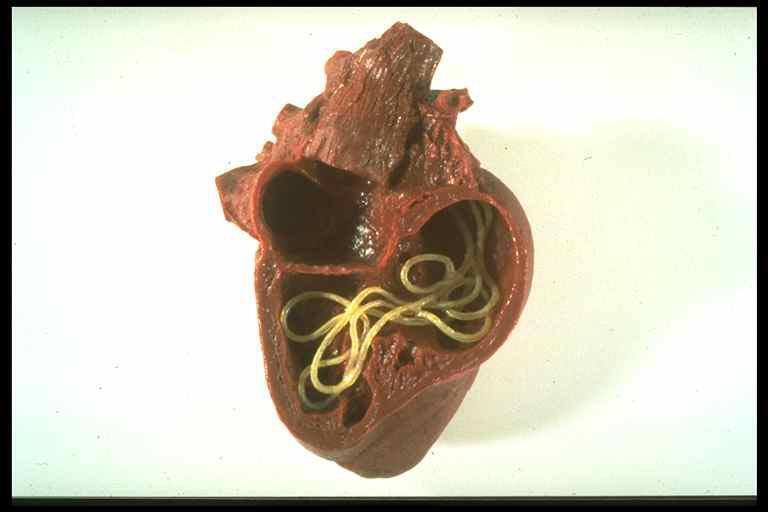
Adult heartworms primarily inhabit the pulmonary arteries—the blood vessels carrying blood from the heart into the lungs—and, with heavier infections, can involve the heart itself.
Dogs are the natural host.
That means heartworms are particularly well adapted to surviving, maturing, reproducing, and completing their life cycle inside dogs.
Cats are different.
Cats are considered more resistant hosts.
Many immature worms never reach adulthood in cats, and adult worm burdens tend to be much smaller.
But don't mistake fewer worms for less dangerous disease.
A cat may have only one or two adult worms and still become seriously ill.
How Does a Dog or Cat Actually Get Heartworms?
The heartworm life cycle requires two players:
An infected animal and a mosquito.
Here's how it happens.
Stage 1: A Mosquito Bites an Infected Animal
An infected dog or another suitable host may have microscopic immature heartworms called microfilariae circulating in the bloodstream.
A mosquito takes a blood meal and ingests those microfilariae.
Stage 2: The Parasite Develops Inside the Mosquito
The heartworm larvae continue developing inside the mosquito.
Eventually they reach an infective larval stage.
The mosquito is now capable of transmitting heartworm infection.
Stage 3: The Mosquito Bites Your Pet
When that infected mosquito feeds on another dog or cat, infective larvae are deposited around the bite wound and enter the animal's body.
This is the moment heartworm infection begins.
Stage 4: The Larvae Develop Inside the Pet
The larvae migrate and continue developing over the following months.
Eventually, surviving worms reach the blood vessels of the lungs and mature toward adulthood.
Stage 5: Adult Heartworms Become Established
In dogs, mature male and female heartworms can reproduce and release microfilariae into the bloodstream.
Those microfilariae can then be picked up by another mosquito.
And the cycle begins again.
From infection to mature adult worms capable of reproduction takes approximately 6 to 7 months in dogs.
This long developmental period is one reason a recently infected dog can test negative.
Today's negative heartworm test does not necessarily tell us what happened after a mosquito bite last month.
Heartworms Aren't Really Just a “Heart” Problem
The name can be misleading.
Heartworm disease causes major damage to the pulmonary arteries and lungs, not simply the heart.
As worms live in the pulmonary vasculature, they contribute to inflammation and vascular injury.
Over time, disease can lead to:
- Pulmonary artery damage
- Lung inflammation
- Increased resistance to blood flow through the lungs
- Exercise intolerance
- Coughing
- Heart strain
- Heart failure in advanced disease
- Other organ damage
- Potentially fatal complications
And here's something many owners don't realize:
A dog can have significant heartworm disease before looking seriously ill.
The absence of obvious symptoms does not mean the infection is harmless.
Dogs and Cats Experience Heartworms Very Differently
Dogs Are the Natural Host
Dogs may develop substantial adult worm burdens.
Without treatment, those worms can survive for years while progressively damaging the pulmonary vasculature.
Cats Are an Atypical Host
Cats generally have fewer adult worms.
Sometimes only one or two.
But cats can develop significant inflammatory lung disease associated with immature heartworms even when those worms never mature into adults.
This syndrome is often called:
Heartworm-associated respiratory disease, or HARD.
A cat can therefore suffer clinically important consequences from heartworm infection even without the type of adult worm burden we typically see in dogs.
Can Indoor Cats Get Heartworms?
Yes.
An indoor cat doesn't need to go outside.
The mosquito needs to come inside.
Mosquitoes enter homes through:
- Open doors
- Window screens
- Garages
- Small openings
- Normal household traffic
Being indoors can reduce certain environmental exposures.
It does not create a mosquito-proof barrier.
And because there is no approved adulticide drug treatment for feline heartworm infection, prevention deserves serious consideration even for indoor cats.
What Does Heartworm Disease Look Like in Dogs?
Early infections may cause no obvious signs.
As disease progresses, owners may notice:
- Coughing
- Reduced stamina
- Exercise intolerance
- Fatigue
- Difficulty breathing
- Weight loss
- Decreased appetite
- Weakness
Severe disease may eventually result in heart failure or caval syndrome, a life-threatening condition associated with a heavy worm burden obstructing blood flow.
Caval syndrome is a true emergency and may require surgical removal of worms.
What Does Heartworm Disease Look Like in Cats?
Feline heartworm disease can be frustratingly unpredictable.
Signs may include:
- Coughing
- Wheezing
- Rapid breathing
- Difficulty breathing
- Vomiting
- Decreased appetite
- Weight loss
- Lethargy
Some cats develop dramatic respiratory or neurologic signs.
And tragically:
Sudden death can sometimes be the first obvious sign.
That's one reason feline heartworm disease deserves far more attention than it receives.
Why Is Heartworm Testing Harder in Cats?
Heartworm testing in dogs and cats isn't identical.
Dogs are much more likely to harbor mature female worms that can be detected with commonly used antigen tests.
Cats may have:
- Very few adult worms
- Only male worms
- Immature infections
- Worms that die before reaching adulthood
That makes diagnosis much more challenging.
Veterinarians may use a combination of:
- Antigen testing
- Antibody testing
- Chest radiographs
- Echocardiography
- Other laboratory findings
No single feline test answers every heartworm question.
Why Do We Recommend Heartworm Prevention Year-Round?
Because trying to outguess mosquitoes is a bad prevention strategy.
Pet owners sometimes think:
“It's winter. There aren't any mosquitoes. I'll restart prevention in spring.”
There are several problems with that approach.
Weather is unpredictable.
Mosquito seasons vary.
Indoor environments can extend mosquito survival.
Travel changes exposure.
And heartworm preventives work against susceptible immature stages of the parasite—they don't create a magical force field around the pet that prevents a mosquito from biting.
Consistency matters.
That's why the American Heartworm Society recommends year-round heartworm prevention with an FDA-approved preventive.
The easiest schedule to remember is:
12 months a year. Every year.
Why Does My Dog Still Need a Heartworm Test if I Never Miss Prevention?
Because no prevention program is perfect.
Monthly doses can be:
- Forgotten
- Given late
- Spit out
- Vomited
- Improperly administered
- Inadequately absorbed
Topical products can be incorrectly applied.
Even excellent preventives need excellent compliance.
Routine testing gives us another layer of protection.
For dogs, the American Heartworm Society recommends year-round prevention along with regular heartworm testing as directed by the veterinarian.
Prevention and testing work together.
My Dog Tested Positive. What Happens Now?
First:
Don't panic.
Heartworm disease in dogs is treatable in many cases.
But treatment should be taken seriously.
Once a positive antigen result is obtained, your veterinarian will typically work to confirm the diagnosis before beginning the complete treatment process.
Your dog may also need evaluation to determine disease severity and whether additional stabilization is required.
Then one of the most important changes begins immediately:
Exercise restriction.
Why Exercise Restriction Is So Important
This is not optional.
Physical activity increases blood flow through damaged pulmonary vessels.
During heartworm treatment—particularly as worms begin dying—the lungs must process inflammatory debris and fragments from dead and dying worms.
That increases the risk of serious pulmonary complications.
The American Heartworm Society recommends restricting exercise once heartworm infection has been confirmed.
For many dogs, that means:
- Leash walks for bathroom breaks
- No running
- No fetch
- No dog park
- No rough play
- No long walks
- No vigorous training
- No uncontrolled backyard exercise
For highly energetic dogs, veterinarians may need to discuss safe strategies to reduce excitement and activity.
A dog may feel perfectly normal and still require strict restriction.
That's one of the hardest parts for owners to understand.
What Is the American Heartworm Society Treatment Protocol?
For appropriate heartworm-positive dogs, the recommended approach is a multimodal treatment protocol.
It is not simply:
“Give an injection and kill the worms.”
The protocol is deliberately staged.
Treatment commonly involves:
- Beginning or continuing an appropriate macrocyclic lactone heartworm preventive
- Doxycycline therapy to target Wolbachia bacteria associated with heartworms
- Strict exercise restriction
- Evaluation and stabilization as needed
- A three-dose melarsomine adulticide protocol
- Anti-inflammatory therapy such as prednisone when indicated
- Continued heartworm prevention
- Follow-up testing
The recommended three-dose melarsomine protocol uses one injection followed later by two injections approximately 24 hours apart.
Each phase has a purpose.
This is why heartworm treatment should be managed as a carefully controlled veterinary protocol rather than improvised at home.
What Is Wolbachia—and Why Does Doxycycline Matter?
Heartworms carry bacteria called Wolbachia.
These bacteria have a symbiotic relationship with the parasite.
When heartworms die, Wolbachia-associated material can contribute to the inflammatory response.
Doxycycline helps reduce Wolbachia organisms and weakens the heartworms before adulticide treatment.
This is one reason modern heartworm treatment is multimodal.
We're not simply trying to kill worms.
We're trying to eliminate the infection while reducing complications as much as possible.
The Truth About “Slow Kill” Heartworm Treatment
You've probably heard someone say:
“You don't need the injections. Just keep the dog on prevention and slowly kill the worms.”
This is commonly called:
“Slow kill.”
And I want owners to understand why this should not be viewed as an equivalent, easier version of standard heartworm treatment.
Protocols relying on preventive medications—with or without doxycycline—to gradually eliminate adult worms may take a year or considerably longer.
During that time:
The adult worms are still there.
They can continue contributing to damage in the pulmonary vasculature.
Worm death is less predictable.
Exercise restriction may be required for a prolonged period.
And eliminating the adult worms is less reliable than recommended melarsomine adulticide treatment.
The American Heartworm Society therefore does not recommend slow kill as the treatment of choice when standard adulticide therapy can appropriately be performed.
In circumstances where melarsomine cannot be used, a veterinarian may need to consider alternative management.
But that's a salvage situation, not evidence that slow kill is an equivalent treatment.
Leaving adult worms alive longer gives them more time to damage the lungs.
Is Melarsomine the Actual Adult Heartworm Treatment?
Yes.
Melarsomine dihydrochloride is the FDA-approved medication used to kill adult heartworms in dogs.
The American Heartworm Society recommends the three-dose protocol for appropriate dogs.
It's important to distinguish adulticide treatment from other medications used during the protocol.
Doxycycline has an important role.
Heartworm preventives have an important role.
Prednisone may have an important role.
But they do not simply substitute for recommended adulticide therapy in a dog that is an appropriate candidate for melarsomine.
Are There Heartworm Preventives That Can Be Used in Heartworm-Positive Dogs?
This is an area where owners should never make assumptions from a product shelf or online medication list.
Heartworm preventives are primarily designed to prevent new infections by eliminating susceptible immature stages.
A heartworm-positive dog still needs prevention during treatment because we don't want new infections developing while we're dealing with the existing one.
However, product selection matters.
Some preventives have specific label information regarding use in heartworm-positive dogs, microfilariae, or precautions surrounding infected animals.
For example, Advantage Multi for Dogs, containing imidacloprid and moxidectin, has FDA-approved labeling for eliminating circulating microfilariae in heartworm-positive dogs.
That does not mean it replaces melarsomine adulticide treatment for adult heartworms.
It addresses a different stage of the infection.
This is why the preventive used during treatment should be selected by the veterinarian managing the case.
Don't simply continue, stop, or switch products on your own after a positive test.
How Long Does Heartworm Treatment Take?
Owners are often surprised by the timeline.
The active treatment protocol unfolds over several months.
And follow-up testing extends the overall commitment further.
A typical dog may begin with:
- Diagnosis and confirmation
- Exercise restriction
- Heartworm preventive
- Doxycycline
- Pretreatment period
- First melarsomine injection
- Additional waiting period
- Second and third melarsomine injections
- Continued strict exercise restriction during recovery
- Follow-up testing later to confirm treatment success
So when I prepare an owner for heartworm treatment, I don't describe it as:
“Three injections.”
I describe it as a multi-month medical commitment, with follow-up extending beyond the injection phase.
For many families, thinking in terms of roughly six months from diagnosis through important post-treatment reassessment provides a much more realistic picture than thinking treatment ends after the final injection.
Should Heartworm Treatment Wait Until Winter?
Not automatically.
Owners sometimes hear that a heartworm-positive dog shouldn't be treated during hot summer months.
There is an understandable practical concern behind this idea:
Exercise restriction can be harder during certain seasons, and treatment planning should account for heat, excitement, lifestyle, and the dog's overall medical condition.
But summer itself is not a reason to leave adult heartworms untreated for months.
Remember:
Living worms continue damaging pulmonary blood vessels while we wait.
Once heartworm infection is confirmed, exercise should be restricted and the veterinarian should determine when the dog is medically ready to proceed.
Treatment timing should be based on the individual patient, not simply the month on the calendar.
Why Leash Walking Matters So Much
A heartworm-positive dog shouldn't be turned loose in the yard to sprint simply because the treatment injections haven't happened yet.
Exercise restriction begins when the diagnosis is confirmed.
Leash walking allows owners to control:
- Speed
- Distance
- Excitement
- Sudden running
- Interaction with other dogs
For bathroom breaks:
Calm, controlled, short leash walks are the goal.
This can be especially difficult for young or energetic dogs.
Talk with your veterinarian before treatment begins about how your household will realistically manage activity restriction.
Planning ahead matters.
Can Cats Be Treated for Heartworms?
This is where heartworm prevention becomes even more important.
There is no approved drug therapy that safely eliminates adult heartworms in cats.
Melarsomine—the adulticide used in dogs—is not considered safe or approved for treating feline heartworm infection.
Veterinary care for a heartworm-positive cat therefore focuses on:
- Evaluating disease severity
- Monitoring
- Managing inflammation
- Treating respiratory or cardiac complications
- Providing supportive care when needed
- Maintaining heartworm prevention to prevent new infections
In selected severe cases, specialized surgical removal of worms may sometimes be considered.
But there is no feline equivalent of the standard canine melarsomine protocol.
For cats, prevention isn't merely easier than treatment.
Prevention is our primary defense because we do not have an approved adulticide treatment option.
Can a Cat Eventually Clear Heartworms?
Sometimes.
Adult heartworms generally survive for a shorter period in cats than in dogs, and some cats can outlive the infection.
But that does not make “waiting for the worms to die” harmless.
The cat may experience significant pulmonary inflammation and permanent damage during infection.
And worm death itself can trigger severe inflammatory reactions.
So spontaneous clearance doesn't mean:
“Heartworms aren't serious in cats.”
Quite the opposite.
The unpredictability of feline heartworm disease is part of what makes prevention so important.
Common Heartworm Myths Pet Owners Need to Stop Believing
MYTH: “My pet stays inside, so heartworm isn't a concern.”
FACT: Mosquitoes enter homes. Indoor cats and dogs can still be exposed.
MYTH: “I only need prevention during mosquito season.”
FACT: The American Heartworm Society recommends year-round prevention.
MYTH: “My dog takes prevention, so we don't need testing.”
FACT: Routine testing remains an important part of canine heartworm prevention.
MYTH: “Slow kill is basically the same treatment without the expensive injections.”
FACT: It is not equivalent to recommended adulticide therapy and allows adult worms to remain longer while pulmonary damage may continue.
MYTH: “My dog feels fine, so we don't need to restrict activity yet.”
FACT: Exercise restriction begins once infection is confirmed.
MYTH: “Once my dog gets the final injection, we're done.”
FACT: Post-treatment exercise restriction and later testing remain critical.
MYTH: “Cats don't really get heartworms.”
FACT: Cats absolutely can develop heartworm disease, and even a small number of worms can cause serious consequences.
MYTH: “If my cat gets heartworms, we'll just treat it like a dog.”
FACT: There is no approved adulticide drug treatment for feline heartworm infection.
Prevention Is the Part We Can Control
Think about the difference.
Prevention
An appropriate veterinary-recommended heartworm preventive.
Given consistently.
Year-round.
Routine testing where indicated.
Heartworm Disease in a Dog
Diagnostic testing.
Months of treatment.
Doxycycline.
Adulticide injections.
Multiple veterinary visits.
Strict exercise restriction.
Potential complications.
Follow-up testing.
Heartworm Disease in a Cat
No approved adulticide drug treatment.
Potential respiratory disease.
Possible emergency complications.
Monitoring.
Supportive care.
Uncertainty.
When you compare those paths, the value of prevention becomes very clear.
Modern Veterinary Insight: Prevention Is About Breaking the Life Cycle Before Adult Worms Exist
One of the most important things owners can understand about heartworm preventives is that we're targeting the infection before adult heartworms become established.
That's why consistency matters so much.
Once mature adult worms are living in the pulmonary arteries, the conversation changes completely.
In dogs, we're now discussing adulticide treatment, inflammation, pulmonary damage, and months of restricted activity.
In cats, we don't even have an approved medication to safely eliminate those adult worms.
So the goal isn't:
“We'll deal with heartworms if they happen.”
The better medical strategy is:
“Don't give the parasite the opportunity to reach adulthood.”
That's preventive medicine.
A Final Thought From Dr. Pam
I've seen owners feel terrible when their pet is diagnosed with heartworms.
Sometimes they missed prevention.
Sometimes they misunderstood how heartworms were transmitted.
Sometimes they believed winter meant they could stop.
And sometimes they simply didn't realize how serious the disease could become.
My goal isn't to make anyone feel guilty.
It's to make sure you understand the disease before you're sitting in an exam room hearing the words “heartworm positive.”
Heartworm prevention is one of those areas of veterinary medicine where a relatively simple decision can prevent an incredibly complicated problem.
Give prevention consistently.
Give it year-round.
Keep your dog's recommended heartworm testing current.
Protect your cat too—even if that cat lives indoors.
And if your dog ever does test positive, follow a veterinarian-directed treatment plan based on current American Heartworm Society recommendations.
Don't look for shortcuts.
Because the longer adult heartworms remain alive, the longer they have to damage the lungs and blood vessels.
Prevention isn't just easier.
It's safer, simpler, and far kinder to the pet than treating established heartworm disease.
Bottom Line
Here's what every dog and cat owner should know about heartworms:
- Heartworms are transmitted through infected mosquitoes
- Pets do not directly transmit heartworms to one another
- Dogs are the natural host
- Cats can absolutely develop serious heartworm disease
- Indoor pets are not completely protected from mosquitoes
- Heartworm development takes months
- Adult worms primarily damage the pulmonary arteries and lungs
- Dogs can have significant disease before showing obvious symptoms
- Cats may become seriously ill from only a small number of worms
- The American Heartworm Society recommends year-round prevention
- Dogs still need routine heartworm testing as recommended
- Confirmed heartworm-positive dogs need immediate exercise restriction
- Controlled leash walking is essential during treatment
- Melarsomine is the FDA-approved adulticide used to kill adult heartworms in dogs
- The recommended canine approach is a multimodal protocol, not simply three injections
- “Slow kill” is not the recommended treatment of choice when standard adulticide therapy can be appropriately performed
- A heartworm-positive dog still needs veterinarian-directed prevention during treatment
- Certain products have specific labeling relevant to heartworm-positive dogs, so product selection should be made by the veterinarian
- Heartworm treatment is a multi-month commitment, with important follow-up extending beyond the injections
- Treatment should not automatically be postponed simply because it is summer
- There is no approved adulticide drug treatment for cats
- Prevention is therefore especially important for cats
And if there's one sentence I want you to remember:
Heartworm disease is transmitted in a moment—but dealing with the consequences can take months, and in cats, we don't have an approved drug that can eliminate the adult worms.
🐾 Want Help Making Smarter Pet Health Decisions?
If this article helped you feel more informed or supported, I’d love to stay connected.
Subscribe to the free weekly PetLovers United newsletter for veterinarian-led education, practical tips, and real-life insights that help you care for the pets you love.
👉 https://www.petlovers-united.com/newsletter
And if you want deeper guidance, tools, and direct support:
Explore the PetLovers United membership, where we help you recognize problems earlier, ask better questions, and confidently care for your pet at every stage of life.
👉 https://www.petlovers-united.com/membership-comparison
PetLovers United | www.petlovers-united.com | Educational Content Only
Enjoying The Blogs? Stay Connected
Join our Free Educational Community to help you make informed decisions and become your pet's best advocate.
Always free. No membership required.

Opening Hours:
Monday – Friday 8am – 9pm
Phone: (310) 495 – 7015
Email: info@PetLoversUnited.com
Address:
Opening Hours:
Monday – Friday 8am – 9pm
Phone: (310) 495 – 7015
Email: info@petlovers-united.com
10 Franklin Hwy.
Suite 188
Newnan, GA 30263
USA